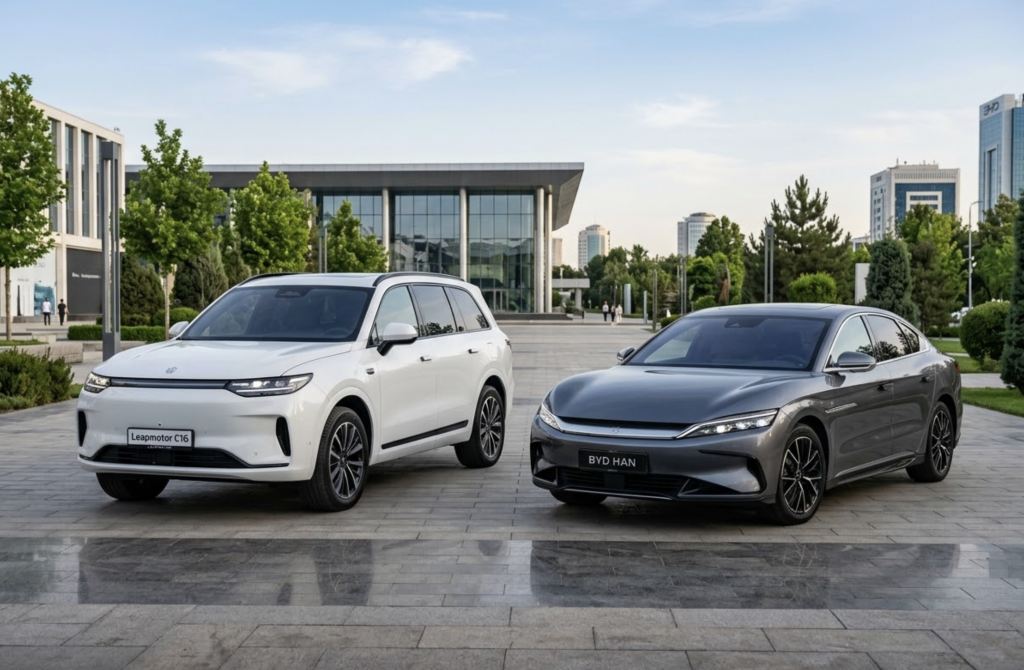
If you’re looking at the Leapmotor C16 and wondering how it stacks up against the BYD Han, you’re asking the right question. Both are Chinese premium electric vehicles available in Tashkent, both make a strong case for themselves — and they’re actually built for very different types of people.
The Leapmotor C16 is a three-row SUV with six seats, backed by Stellantis and built around family or group travel. The BYD Han is a flagship electric sedan that goes from 0 to 100 in 3.9 seconds and looks like it belongs at a business dinner. Same premium EV segment, completely different answers to the question of what a car should be.
Let’s break it down properly.
Design: Two Different Philosophies
The Leapmotor C16 is a large SUV — 4,915 mm long, 1,905 mm wide, 1,770 mm tall. It’s built to look bold without being aggressive: clean body lines inspired by the smaller C10, a closed front grille with a thin LED strip running across it, retractable door handles, and a panoramic glass roof. The 20-inch alloy wheels and the overall proportions give it a presence on the road that’s hard to miss.
Inside, the Leapmotor C16 takes a minimalist approach. The 14.6-inch touchscreen dominates the center console, powered by a Qualcomm Snapdragon 8295 chip. Physical buttons are minimal. The 2+2+2 seating layout gives all six passengers their own proper seat — not the squeeze-in kind. A 15.6-inch fold-down entertainment screen sits in the ceiling for second and third-row passengers.
The BYD Han, on the other hand, is a proper full-size sedan — 4,995 mm long, 1,910 mm wide, but only 1,495 mm tall. It’s sleek, low, and unmistakably car-shaped. The 2021 iF Design Award it won wasn’t a marketing exercise — the Han genuinely looks considered and premium, especially in dark colors.
Inside the Han: Nappa leather, a 15.6-inch rotating central screen, wood trim accents, and a cabin that seats five in real comfort. Driver’s seat is 8-way electrically adjustable. Both front seats have heating, ventilation, and cooling.
Bottom line: The Leapmotor C16 feels like a spacious family SUV done right. The BYD Han feels like a luxury business sedan. Different animals.
Specifications Compared
| Specification | Leapmotor C16 (BEV) | BYD Han (AWD EV) |
|---|---|---|
| Body type | 3-row SUV | Full-size sedan |
| Seats | 6 (2+2+2) | 5 |
| Length | 4,915 mm | 4,995 mm |
| Height | 1,770 mm | 1,495 mm |
| Wheelbase | 2,825 mm | 2,920 mm |
| Motor setup | Single rear motor | Dual motor AWD |
| Power | 292 hp | 510 hp (AWD) |
| Torque | 360 Nm | 700 Nm |
| 0–100 km/h | 6.4 sec | 3.9 sec |
| Battery | 74.9 kWh LFP | 85.4 kWh LFP |
| Range (CLTC) | 580 km | 715 km (long range) / 610 km (AWD) |
| Fast charge (30–80%) | ~15 min (DC) | ~25 min |
| Top speed | 160 km/h | 185 km/h |
| Drive | RWD | AWD |
| Trunk | 209–1,022 L | 440 L |
Range: How Far Can You Actually Go?
The Leapmotor C16 BEV has a 74.9 kWh LFP battery with a CLTC range of 580 km. The updated 2026 model takes this to 630 km with an 81.9 kWh pack. In real-world conditions around Tashkent — mixed city and highway driving — expect around 420–470 km per charge.
The Leapmotor C16 also comes in an EREV (extended-range hybrid) variant. This version adds a 1.5-litre petrol generator alongside the electric motor, pushing total range to around 1,150 km with a full tank and full charge. For anyone planning a full Uzbekistan road trip — Tashkent, Samarkand, Bukhara, Khiva — the EREV version essentially eliminates range anxiety.
The BYD Han AWD version delivers 610 km on the CLTC cycle, with the long-range RWD version reaching 715 km. Real-world figures sit around 480–530 km depending on speed and climate control usage. Fast charging takes the battery from 10% to 80% in about 25 minutes — respectable for a vehicle this size.
For a Tashkent–Samarkand round trip (around 700 km), both vehicles can handle it on a single charge with careful driving — or with one short charging stop on the way back.
Interior & Comfort: Who Does It Better?
This is where the Leapmotor C16 and BYD Han take sharply different approaches, and the answer really depends on who’s riding.
Leapmotor C16: Six proper seats across three rows. All seats have power adjustment, heating, and ventilation. The second row also gets a fold-out tray table from the front seat backrests and the ability to recline fully. The ceiling-mounted 15.6-inch entertainment screen is a genuine feature — great for kids in the third row, or for anyone on a longer journey. Luggage space ranges from 209 litres with all seats occupied to 1,022 litres with the third row folded. The 2026 model adds a built-in 8.1-litre refrigerator and a 21-speaker audio system with Dolby Atmos.
BYD Han: Five seats in proper business-sedan comfort. The Nappa leather upholstery, ambient lighting, and the rotating 15.6-inch screen make the cabin feel genuinely premium. Trunk space is 440 litres — solid for a sedan. The DiSus-C intelligent damping system on the 2025 model adjusts suspension in real time for either comfort or stability, which makes a noticeable difference on Uzbekistan’s varied road surfaces.
If you’re traveling with family or a group of six, the Leapmotor C16 wins outright — there’s simply no alternative in its segment. If you’re traveling as a couple or solo for business, the BYD Han’s level of finish and driving dynamics are hard to match at this price point.
Charging in Tashkent
Charging infrastructure in Tashkent has grown noticeably over the last two years. Fast charging stations are available at several major shopping centers, including Riviera, Compass, and various standalone EV charging points across the city.
Both the Leapmotor C16 and BYD Han use GB/T connectors — standard for Chinese EVs. DC fast charging gets the C16 from 30% to 80% in around 15 minutes. The Han takes about 25 minutes for the same charge range. Both also support AC charging from a standard outlet, though that takes considerably longer overnight.
For trips outside Tashkent, Samarkand has a growing number of charging points, though coverage in more remote areas is still limited. The EREV version of the Leapmotor C16 sidesteps this concern entirely — you just fill up with petrol when needed.
Performance: Fast vs. Fast Enough
The BYD Han AWD is genuinely fast. 510 hp, 700 Nm, 0–100 km/h in 3.9 seconds — numbers that sit alongside sports sedans costing two or three times more. Top speed of 185 km/h. The dual-motor AWD system provides confident traction in all conditions, and the instant electric torque makes overtaking on the highway feel effortless.
The Leapmotor C16 is not trying to be that. 292 hp, 0–100 in 6.4 seconds, top speed 160 km/h. For a six-seat family SUV carrying a full load, these are perfectly adequate numbers. The drive is smooth and quiet — the electric powertrain makes urban driving genuinely pleasant.
If performance is what you’re after, the BYD Han is the obvious choice. If you need to move a group comfortably and efficiently, the Leapmotor C16 does exactly what it promises.
Which One Should You Rent?
Choose the Leapmotor C16 if:
- You’re traveling with a group of 5–6 people
- You need a large boot for luggage
- You want the EREV option for a road trip across Uzbekistan without charging worries
- Family travel with kids in the third row
Choose the BYD Han if:
- You’re traveling for business and want a polished, fast sedan
- There are 2–4 passengers maximum
- Performance and driving dynamics matter to you
- You want something that makes an impression at arrival
Both are available in the Orient Rent Car premium fleet. Check current availability and dates on the website, or message the team directly if you’re not sure which one fits your plans.
→ Browse premium EVs at Orient Rent Car
FAQ
Is the Leapmotor C16 available as a hybrid in Tashkent? The C16 comes in both pure electric (BEV) and extended-range hybrid (EREV) variants. The EREV version adds a petrol generator for total range of over 1,000 km. Check with Orient Rent Car for current fleet availability.
How fast is the BYD Han to charge? The BYD Han charges from 10% to 80% in approximately 25 minutes using a DC fast charger. From a standard AC outlet, a full charge takes around 8–10 hours.
Can I drive these EVs outside Tashkent? Yes — both vehicles can be driven anywhere in Uzbekistan under standard rental terms. Samarkand, Bukhara, Khiva and other destinations are covered. The Leapmotor C16 EREV is especially practical for longer routes where charging infrastructure may be limited.
Which is more comfortable for passengers? The Leapmotor C16 wins for group travel — six seats, three rows, entertainment screen, and a large boot. For two to four passengers who prioritize cabin quality, the BYD Han’s Nappa leather interior and refined ride are hard to beat.
What driving licence do I need? Standard category B licence is sufficient for both the Leapmotor C16 and BYD Han. No additional categories required.
Are there charging stations along the Tashkent–Samarkand highway? Charging infrastructure on this route is developing. As of 2026, there are options available in both cities. For the most reliable option on this route, the Leapmotor C16 EREV removes the need to plan around charging stops entirely.