
Premium car rental in Tashkent is more accessible than most foreign visitors expect. The city has a solid fleet of well-maintained vehicles — from Toyota Land Cruiser 200 to Kia Carnival Hi-Limousine and Chinese electric SUVs — and prices that compare favourably to Europe or the Middle East. This guide covers everything you need to know: which cars are available, what they cost, how booking works, and what documents you’ll need.
Whether you’re here for business, visiting Uzbekistan’s Silk Road cities with family, or just want the freedom to move around on your own schedule — a premium rental is often the most practical choice.
Why Rent a Premium Car in Tashkent
Taxis are cheap and widely available in Tashkent. So why rent? A few reasons that come up again and again with travellers who’ve done both:
Your own schedule. Tashkent to Samarkand is 350 km. If you want to leave at 6am, stop at Jizzakh for tea, and arrive at the Registan before the crowds — a rental car makes that possible. A shared transfer doesn’t.
Group travel. If there are four or more of you, splitting the cost of a premium car rental often works out cheaper than four separate taxis — and considerably more comfortable.
Privacy. Business travellers and delegations often prefer not to have conversations in front of an unfamiliar driver. A self-drive rental solves that immediately.
Outside the city. Getting to Chimgan mountains, Charvak lake, or the Fergana Valley independently is very difficult without your own vehicle. The premium fleet at Orient Rent Car includes AWD SUVs suited to these routes.
The Premium Fleet: What’s Available in Tashkent
Toyota Land Cruiser 200
The most recognisable premium rental in Tashkent. The Land Cruiser 200 ran from 2007 to 2021 and remains the default choice for corporate clients, delegations, and anyone heading outside the city. Seven seats, permanent 4WD, 225 mm ground clearance, and a 93-litre tank that covers around 600 km on a single fill.
Engine options: 4.6-litre V8 petrol (309 hp) or 4.5-litre diesel V8 (249 hp). The petrol version is more common in Uzbekistan — quieter, simpler to service, runs on AI-95. Fuel consumption in mixed driving: around 14–16 litres per 100 km.
Best for: business delegations, family road trips across Uzbekistan, mountain routes.
Kia Carnival Hi-Limousine
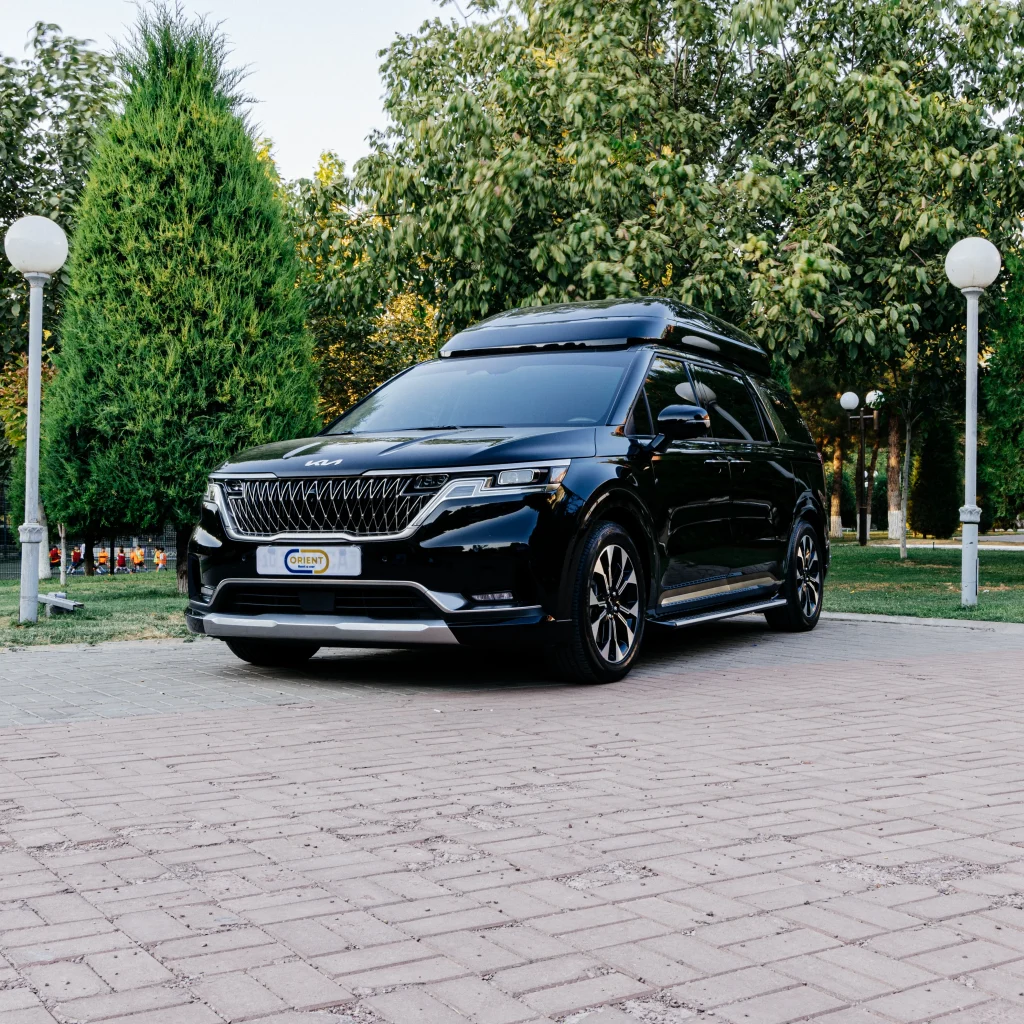
Available in 6-seat (VIP) and 9-seat configurations. The Hi-Limousine version has a raised roof (+291 mm over the standard Carnival), captain seats in the second row with heating, ventilation, massage functions, and a 21.5-inch entertainment screen built into the front seat backrests.
Engine: 3.5-litre V6, 294 hp, front-wheel drive. Fuel consumption: around 11–12 litres per 100 km. Standard category B driving licence is sufficient for both the 6 and 9-seat versions.
Best for: wedding transport, VIP airport transfers, group travel, corporate events.
Leapmotor C16
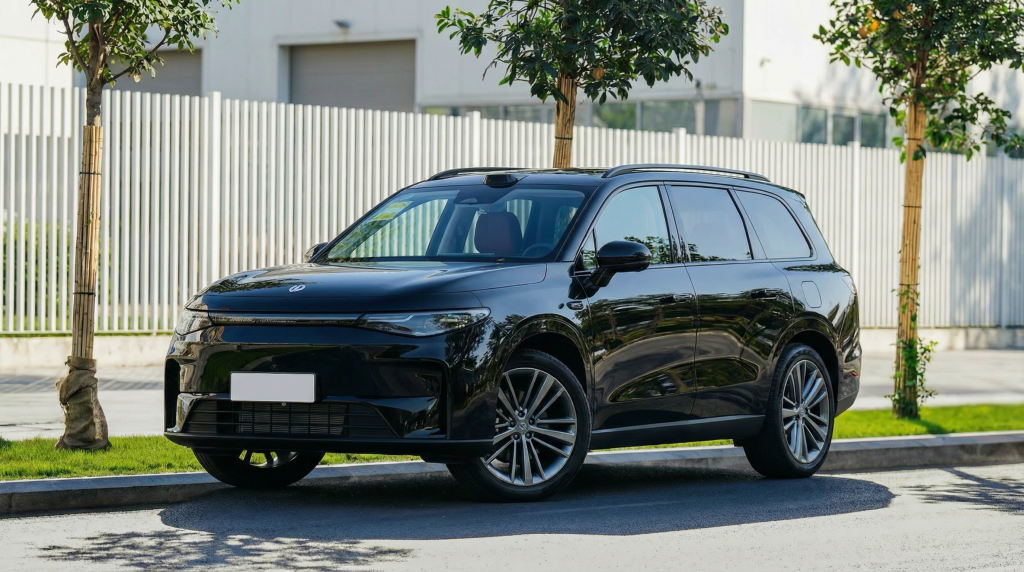
A three-row electric SUV backed by Stellantis, with a 14.6-inch touchscreen, LiDAR sensor, and 580 km of electric range (CLTC). The extended-range hybrid (EREV) version adds a petrol generator for a total range exceeding 1,000 km — practical for multi-city Uzbekistan road trips without worrying about charging infrastructure.
Six seats in a 2+2+2 layout. Compact in appearance but spacious inside: 1,022 litres of boot space with the third row folded.
Best for: eco-conscious travellers, tech-forward clients, family travel, long-distance routes.
Voyah Free Hybrid
A Chinese premium SUV with a sequential hybrid drivetrain. The 1.5-litre petrol engine acts as a generator, feeding two electric motors (combined 490 hp). Total range up to 1,201 km on the CLTC cycle. Adaptive air suspension adjustable over a 100 mm range — useful for varied road quality across Uzbekistan.
Best for: long-distance travel, business travellers who want something distinctive, anyone who values fuel economy.
BYD Han
A full-size electric sedan, 4,995 mm long, 510 hp in the AWD version, 0–100 km/h in 3.9 seconds. Range: 610 km (CLTC). Nappa leather, a 15.6-inch rotating screen, and a cabin that’s been compared to entry-level German luxury sedans.
Best for: business travel for 2–4 people, airport transfers, city driving.
Prices: What to Budget in USD
Premium car rental in Tashkent is priced in Uzbek som, but for international visitors, here are approximate daily equivalents based on current exchange rates:
| Vehicle | Approx. price/day (USD) | Seats | Drive |
|---|---|---|---|
| Toyota Land Cruiser 200 | $80–120 | 7–8 | AWD |
| Kia Carnival Hi-Limousine | $70–110 | 6 or 9 | FWD |
| Leapmotor C16 (BEV) | $60–90 | 6 | RWD |
| Voyah Free Hybrid | $70–100 | 5 | AWD |
| BYD Han (AWD) | $60–90 | 5 | AWD |
Prices are approximate and subject to availability and season. Contact Orient Rent Car for exact current rates.
For context: a large SUV rental in Western Europe averages $150–250 per day. Tashkent’s premium market is considerably more accessible.
Deposit: A refundable security deposit is required at the time of rental. The amount varies by vehicle class and is returned after the car is checked back in and any traffic fines are confirmed clear — typically within a few working days.
Documents Required for Foreign Visitors
This is the part most visitors have questions about. Here’s a clear summary:
Driving licence: You need a valid driving licence. If your licence is not in Latin or Cyrillic script, you’ll need an International Driving Permit (IDP). Most Western countries issue these — check with your national automobile association before travelling.
Passport: Required for the rental agreement.
Minimum age: 25 years for premium class vehicles at Orient Rent Car.
Minimum experience: 3 years of driving experience.
CIS countries (Russia, Kazakhstan, Belarus, etc.): Your national driving licence is valid. No IDP needed.
Visa: Uzbekistan offers e-visa to citizens of most countries. EU, UK, US, and many other nationalities can apply online before travel. The process takes 2–3 working days.
How to Book
The simplest way is directly through the Orient Rent Car website. Select your dates, choose your vehicle, and submit a booking request. A manager confirms availability within 15 minutes during business hours.
A few practical notes:
- Book at least 3–5 days ahead during peak season (May–October). Popular models like the Land Cruiser 200 and Carnival Hi-Limousine fill up quickly.
- Airport delivery is available — the car can be ready for you at Islam Karimov International Airport when you land.
- Delivery across Tashkent is standard and typically included.
- If you need a driver rather than self-drive, this is a separate service — ask when you book.
Driving in Uzbekistan: What to Know
Tashkent’s roads are generally well-maintained in the centre, with wider arterial roads and a logical grid system. A few things worth knowing before you drive:
Traffic: Tashkent’s city centre can be congested during morning (8–9am) and evening (5–7pm) rush hours. Outside these windows, the city moves efficiently.
Motorways: The main Tashkent–Samarkand highway is in good condition and takes around 3 hours to drive. Toll roads are being introduced on some sections.
Speed limits: 60 km/h in urban areas, 100 km/h on highways. Speed cameras are present on major routes.
Fuel: AI-95 petrol is widely available. Fuel stations are plentiful in cities and along major highways. In more remote areas — particularly between Bukhara and Khiva — plan ahead and fill up when you can.
Mountains: Roads to Chimgan and Charvak are narrow and can be steep. The Land Cruiser 200 and Voyah Free are the most capable vehicles from the premium fleet for these routes.
Recommended Routes from Tashkent
Tashkent → Samarkand (350 km, ~3 hours) The most popular tourist route in Uzbekistan. The Registan, Shah-i-Zinda, and Gur-e-Amir are all within the city. A good one-way trip if you plan to take the high-speed train back.
Tashkent → Chimgan / Charvak Lake (~80 km, ~1.5 hours) A day trip from the city to the Tian Shan foothills. Charvak reservoir is a scenic mountain lake; Chimgan has ski infrastructure in winter and hiking in summer. A 4WD vehicle is recommended.
Full Silk Road circuit (~2,000 km over 7–10 days) Tashkent → Samarkand → Bukhara → Khiva → Nukus → return. This is the classic Uzbekistan road trip. The Leapmotor C16 EREV or Voyah Free are practical choices for this route — their range largely eliminates the need for frequent fuel stops between cities.
If you’re planning a trip to Uzbekistan and want to move on your own terms, premium car rental in Tashkent is worth considering from the start — not as an afterthought. The fleet is modern, the prices are reasonable, and the freedom it gives you across a country this size is significant.
Check current availability and get in touch with the team directly if you have questions about which vehicle fits your itinerary.
→ Browse the premium fleet at Orient Rent Car
FAQ
Do I need an International Driving Permit to rent a car in Tashkent? It depends on your licence. If your driving licence uses Latin or Cyrillic script, it is generally accepted directly. If it’s in another script (Arabic, Chinese, Korean, etc.), an International Driving Permit is required alongside your national licence.
What is the minimum age for premium car rental in Tashkent? At Orient Rent Car, the minimum age for premium class vehicles is 25 years, with at least 3 years of driving experience.
Can I drive to Samarkand and Bukhara with a rental car? Yes — there are no restrictions on driving across Uzbekistan. The full Silk Road route (Tashkent–Samarkand–Bukhara–Khiva) is a popular self-drive trip, especially with larger vehicles like the Land Cruiser 200.
Is insurance included in the rental price? All vehicles include basic insurance. For more specific details on coverage and excess, check with Orient Rent Car when booking.
How far in advance should I book premium car rental in Tashkent? For peak season travel (May through October), book at least 3–5 days ahead. For holidays and wedding season weekends, a week or more is advisable for popular models.
Can I get the car delivered to the airport? Yes. Airport delivery to Islam Karimov International Airport is available. Arrange this when you book — it’s a common request from arriving international visitors.